



There was a time when the future of the book seemed to be increasingly digital.
Screens were everywhere. Smartphones became our libraries, newspapers, cinemas, diaries, shopping centres and social spaces. Reading could be done on a phone, a tablet or an e-reader, while the traditional printed book began to look, to some, like a technology whose time had passed.
But something rather interesting has happened.
The book did not disappear.
In fact, it appears to be having something of a renaissance.
As we explored in our earlier article on the resurgence of printed books, there are signs that people are actively rediscovering the physical book. Some of that may be a reaction to what has become known as technology fatigue: after spending much of the day surrounded by screens, there is something appealing about picking up an object that asks nothing of you except to turn the page.
There have even been political and educational responses to the renewed importance of reading, with some countries taking steps to make books more accessible and affordable. In 2026, the UK has gone further still, making it the National Year of Reading, with a campaign encouraging people of all ages to rediscover reading for pleasure.
And books are finding their way back into classrooms, libraries and everyday life.
But there is another part of this story that is perhaps even more fascinating.
Technology has not simply survived the return of the book. It has helped make the return possible.
The world’s biggest book club is online
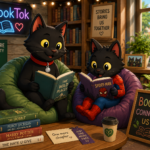
Few examples illustrate this better than TikTok.
At first glance, TikTok might seem like an unlikely place to find a literary revival. It is, after all, one of the world’s most prominent short-form video platforms.
Yet #BookTok has become a huge literary community.
According to TikTok’s latest UK figures, more than 84 million posts have now been created using #BookTok, an increase of 65% over the previous year. Even more strikingly, 51% of 16–25-year-old readers now discover new books through TikTok.
That means a platform built around short videos is helping people discover something that requires them to sit down, slow down and read hundreds of pages.
There is a lovely irony in that.
The smartphone is helping people put the smartphone down.
And it is not simply directing people towards digital books. BookTok is sending readers into bookshops, libraries and the physical world. TikTok says its community is bringing young people back into bookshops and helping new authors build audiences, while BookTok Bestsellers can now be identified in participating bookshops with an official sticker.
In other words, the digital conversation is producing a very tangible result.
People are buying books.
From scrolling to sharing
Perhaps the most important thing about BookTok is that it changes the idea of reading from something solitary into something social.
A traditional book can be an intensely private experience. You read it alone, form your own opinions and perhaps recommend it to a friend.
BookTok takes that conversation and puts it on a global stage.
Someone reads a book. They react to it. They recommend it. Someone else sees the recommendation, buys the book, reads it and responds. A third person joins the conversation. Suddenly a novel published years ago can find an entirely new audience.
It is less like a conventional book club and more like a continuously moving conversation.
TikTok itself has described the phenomenon as the World’s Biggest Book Club, with events and activities designed to bring the online community into real-world spaces as well. In July, for example, TikTok and the British Library brought BookTok into the library itself for an after-hours celebration of reading, storytelling and community.
The distinction between “online” and “offline” starts to become rather meaningless.
The conversation begins on a screen.
The book ends up in someone’s hands.
What are people reading?
The latest UK BookTok Bestsellers list, compiled in partnership with Media Control using both real-world retail data and TikTok engagement, provides an intriguing snapshot of what is currently resonating with readers.
July’s number one was The Family Friend by Claire Douglas, followed by The Secret of Secrets by Dan Brown and Heated Rivalry by Rachel Reid.
The list also demonstrates just how broad the BookTok phenomenon has become. It includes contemporary romance, thrillers, fantasy, young adult fiction and established favourites, alongside new releases and returning titles.
Divergent, Heartstopper Volume 6 and Sunrise on the Reaping sit alongside newer titles, showing that BookTok is not simply a promotional channel for whatever happens to be newly published. Older books can be rediscovered too.
That matters.
Because a culture of reading does not depend upon everyone reading the same book. It depends upon people finding their book.
Technology is not necessarily the enemy
Perhaps this is the bigger lesson.
The debate about technology and reading is often presented as a choice.
Screens or books.
Digital or physical.
Scrolling or reading.
But the reality is considerably more complicated.
Technology can certainly compete for our attention. There is no shortage of evidence that people can spend enormous amounts of time consuming digital content.
But technology can also connect people with ideas, interests and communities that they might never otherwise encounter.
BookTok is a particularly good example.
A teenager who might never have walked into a bookshop can discover a novel because someone their own age recommends it in a 30-second video.
A reader can find people who share their enthusiasm for a particular author or genre.
An aspiring writer can find an audience.
A forgotten title can be rediscovered.
And a bookshop can benefit from a conversation that began thousands of miles away.
The technology has not killed the book.
It has become part of the book’s ecosystem.
A new relationship with reading
The UK’s National Year of Reading 2026 is built around precisely this idea: reading does not have to be confined to one format, one age group or one definition. The campaign encourages people to reconnect with reading through their own passions and interests.
That is important because the future of reading probably will not be purely analogue or purely digital.
It will be both.
People will listen to audiobooks while driving.
They will read articles on phones.
They will borrow e-books from libraries.
They will discover authors through social media.
And then, perhaps, they will buy a printed book, put their phone somewhere out of reach and spend an evening turning pages.
That is not a retreat from technology.
It is a more mature relationship with it.
The real victory is not that books have somehow defeated screens.
It is that people are finding ways to use technology to reconnect with something technology itself cannot replace: the experience of getting lost in a story.
The book is back.
And perhaps, rather wonderfully, one of the things helping to bring it back is the very technology that we once thought might make it obsolete.
Welcome to the new chapter.

Other Articles