


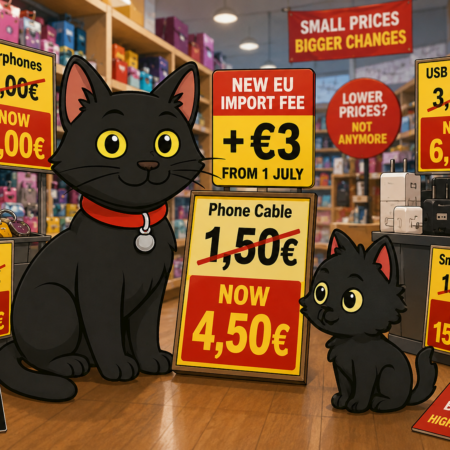

From 1 July, millions of low-value parcels entering the European Union from outside its borders will become subject to a new €3 import handling fee.
Much of the discussion has focused on shoppers using platforms such as Temu and Shein, but the consequences extend much further than bargain shopping.
For many small businesses, this could become one of the biggest changes to online retail in recent years.
A fairer playing field…
European retailers have long argued they have been competing against businesses able to send individual parcels directly from China at prices that local companies simply cannot match.
Unlike many overseas sellers, local businesses pay European taxes, warehousing costs, staff wages, commercial rents and regulatory compliance before a product even reaches the customer.
The new fee is intended to reduce that imbalance.
For independent retailers already importing products in bulk into Europe, the changes could remove some of the pricing advantage enjoyed by direct overseas shipments.
In theory, this creates a more level competitive environment.
…but consumers still pay more
The reality, however, is that market equalisation rarely means prices come down.
Instead, it often means prices rise.
Consumers who have become accustomed to buying €2 gadgets, €3 accessories or inexpensive household items are likely to notice the biggest difference, as the additional charge represents a large proportion of the purchase price.
Even where companies such as Temu absorb part of the increase, retail prices are expected to edge upwards over time.
The forgotten businesses
Perhaps the least discussed impact is on the growing number of micro-businesses operating through dropshipping.
Many sole traders, side-hustle entrepreneurs and online marketplace sellers have built businesses that rely on products being dispatched directly from Chinese suppliers.
If every individual shipment becomes more expensive, their margins become tighter almost overnight.
Some may have to increase prices.
Others may decide to hold stock within Europe, increasing their investment and financial risk.
Some business models may simply become uneconomic.
How Temu is adapting
Temu appears to have anticipated these changes.
The company has been investing heavily in European warehousing, encouraging local merchants onto its platform and restructuring its logistics so more products are already within the EU before customers place an order.
That strategy may soften the impact, but it also demonstrates an important lesson for businesses of every size.
Supply chains evolve.
Businesses that adapt early usually fare better than those waiting for regulations to force change.
Looking ahead
Whether viewed as consumer protection, trade policy or economic fairness, the new import fee marks another step in the changing landscape of international e-commerce.
For local retailers, it may offer an opportunity to compete on more equal terms.
For consumers, it almost certainly means paying a little more.
For thousands of small businesses built around the dropshipping model, it could be the catalyst for a complete rethink of how products are sourced, stored and sold.
In the long term, the winners are likely to be those businesses that see this not as the end of an opportunity, but as the beginning of a different way of trading.
What can businesses learn from this?
Every major change in regulation creates both winners and losers.
Businesses that rely entirely on importing individual low-cost products directly from overseas may need to rethink their model, while those already investing in local stock, faster fulfilment and stronger customer service could find themselves in a more competitive position.
Consumers are unlikely to stop shopping online. Instead, they will become more selective, comparing not just headline prices but delivery times, reliability, returns policies and overall value.
Perhaps the biggest lesson is that successful businesses rarely compete on price alone. Whether you are a multinational marketplace or a sole trader running a side business from home, resilience comes from adapting to change rather than hoping it passes you by.
For many businesses, this new import charge may prove to be less about paying an extra €3, and more about rethinking how products reach customers in the first place.


The Week Ahead: A Summer of Change
The Week Ahead: A Week Under Pressure