


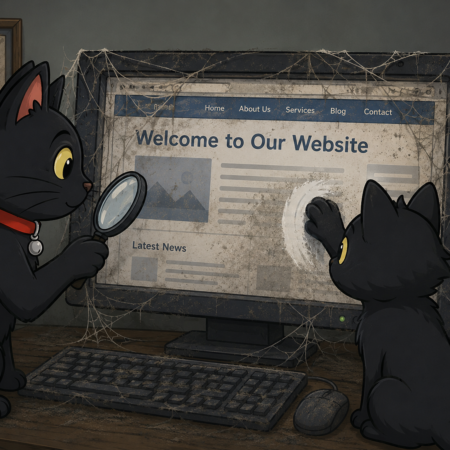

There is a common misconception in website development that progress should be quick, visible, and immediate. When that does not happen, many people lose patience, step away, and promise themselves they will return later.
On the surface, that seems harmless. In reality, it is one of the most damaging decisions you can make.
Because when it comes to websites, momentum is not optional. It is everything.
The First Year Was Never About Traffic
Traditionally, it has been sensible to advise that a website takes around twelve months to gain meaningful traction in search engines. That guidance still holds value today, but it is often misunderstood.
The first year is not about rapid growth. It is about building:
- structure
- clarity
- relevance
- trust
Search engines are not simply indexing pages. They are evaluating consistency, accuracy, and usefulness over time. That process cannot be rushed, and it cannot be simulated.
A slow upward trend is not failure. It is exactly what should be happening.
What Happens When You Stop
When a website is abandoned, even temporarily, several things begin to happen beneath the surface:
- Search engines crawl the site less frequently
- Content becomes dated, even if still technically correct
- Internal links lose relevance as new context is never added
- Signals of reliability and activity begin to fade
The site does not disappear, but it becomes quieter in the eyes of search systems.
And in today’s environment, quiet websites are quickly overlooked.
Restarting Is Not Picking Up Where You Left Off
Many assume that returning to a website means continuing the original journey.
It does not.
Instead, you are dealing with:
- outdated content that needs reviewing or rewriting
- weakened authority in your topic area
- reduced visibility in search results
- a gap in consistency that must be repaired
This creates a two-stage challenge:
- Recover what was lost
- Rebuild what should have been continued
That is why restarting often feels harder than starting from scratch.
The Stop-Start Problem
Repeatedly abandoning and relaunching a site compounds the issue.
Each pause weakens trust signals. Each restart introduces inconsistency. Over time, the website begins to look unreliable, not because of poor intent, but because of broken continuity.
Modern search systems, particularly those influenced by machine learning, prioritise stability and ongoing relevance. A stop-start pattern works directly against that.
The Reality of AI Search
The landscape has changed.
Search engines are no longer just listing websites. They are summarising information, often answering questions before a user even clicks.
This means that:
- generic content is less valuable
- copied or lightly reworked material is effectively invisible
- surface-level articles rarely gain traction
To be seen, a website must offer something that cannot be easily summarised or replicated.
That includes:
- genuine expertise
- clear and structured information
- real-world context
- accuracy that others can rely on
In simple terms, content must be worth citing, not just publishing.
Momentum Matters More Than Ever
Consistency is now one of the strongest signals a website can send.
This does not mean publishing constantly for the sake of it. In fact, that approach can do more harm than good.
Momentum must be:
- deliberate
- accurate
- relevant
- useful
Every piece of content should contribute to a wider structure, reinforcing the purpose of the site and strengthening its authority over time.
When a Website Is Not Enough
It is important to be clear: not all websites provide value simply by existing.
For many small businesses, a traditional “brochure-style” website — a few pages explaining who you are and what you do — no longer serves the purpose it once did.
That role has largely been replaced by platforms such as Google Business listings, mapping services, and social media pages, where customers can quickly find:
- your location
- your opening times
- your reviews
- your reputation
In many cases, that is all the user needs.
A static website that is rarely updated adds little beyond that. It does not build momentum, it does not strengthen authority, and it does not contribute meaningfully to search visibility.
In today’s environment, a website must go further. It must:
- provide useful and relevant information
- demonstrate knowledge or expertise
- remain active and up to date
- contribute something that cannot be easily summarised elsewhere
Without that, the website becomes a passive asset in an active ecosystem.
And passive assets are increasingly overlooked.
A Website Must Justify Its Existence
Perhaps the most important shift is this:
Having a website is no longer enough.
If the content does not provide clear value beyond what can be generated or summarised elsewhere, it will struggle to gain visibility.
Successful websites today tend to fall into one of three categories:
- those offering tangible products or services
- those providing trusted local or specialist information
- those delivering genuine expertise and insight
Anything outside of that must work significantly harder to compete.
The Bottom Line
Stopping a website may feel like a pause. In reality, it is a setback.
Restarting is possible, but it is not a continuation. It is a rebuild.
And in a world where search is increasingly driven by quality, consistency, and trust, the cost of lost momentum is higher than it has ever been.
If a website is worth starting, it is worth maintaining.
Not with noise, not with filler content, but with steady, purposeful progress that builds something reliable over time.
“If a website is only there to say you exist, it is no longer doing enough to justify its existence.”

Other Articles

The Week Ahead: 18 to 24 May 2026