


Traditional advertising is broken, expensive, and largely ignored by consumers who actively dodge pop-ups and commercial breaks. Meanwhile, platform giants like Spotify, Amazon, and TikTok are making millions in the middle simply by connecting buyers with sellers through frictionless digital infrastructure. For small businesses, this shift signals a vital truth: stop wasting money on ads nobody sees and start focusing on direct, personal product delivery.
The Death of Traditional Advertising
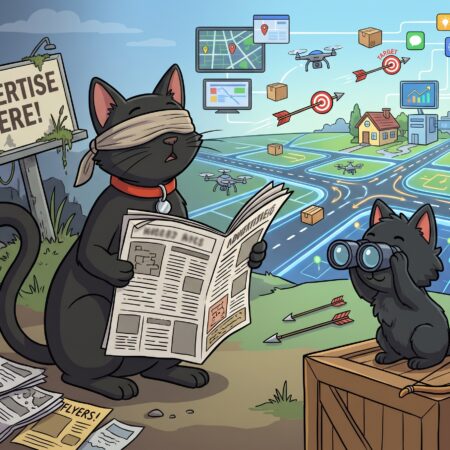
Let us be honest with ourselves for a moment. When was the last time you picked up a newspaper or a magazine and thought, “Oh brilliant, let us see what is advertising today”? When you sit down to watch television, do you stick around for the ad break, or do you use it as an excuse to make a cup of tea or scroll through your phone?
Most people despise adverts. We install ad blockers, skip pre-rolls on videos, and scroll past sponsored posts without batting an eyelid. Yet, despite this widespread consumer hostility towards marketing, billions of pounds are still funnelled into traditional advertising channels every single year. It is a massive gamble, and for small businesses operating on tight budgets, it is a financial trap.
Advertising has always been a punt. You pay for space, cross your fingers, and hope that someone in your target demographic happens to look at the right billboard or tune into the right station at the exact moment your message flashes up. But the world has evolved, and the rulebook has been rewritten.
Millions in the Middle: The Rise of Platform Economics
There is a saying doing the rounds in various business circles right now: millions are made in the middle.
When people talk about this phrase, they are usually referring to platform giants like Spotify, Just Eat, Airbnb, and Facebook. Consider how they operate. Spotify does not own a single musical instrument or record pressing plant, yet music producers and consumers flock to it. Just Eat does not own restaurants, but it connects hungry diners with local takeaways using a seamless global infrastructure. Facebook does not produce content; its users do all the heavy lifting, creating the articles, photos, and videos that keep people hooked.
These companies do not sell products in the traditional sense. They own the connection. They sit squarely in the middle of supply and demand, facilitating transactions and taking a slice of the action. They bridge the gap so efficiently that billions are generated simply by making commerce frictionless.
The TikTok Shop Phenomenon and Impulse Buying
Nowhere is this shift more evident than in the evolution of social commerce, particularly with platforms like TikTok Shop. In markets like China, social selling has moved far beyond traditional banner ads or static product listings.
TikTok Shop thrives on influence, but not in the glossy, heavily scripted celebrity endorsement style of the past. Instead, it relies on real people showing products directly in action. It is visual, fast-paced, and engineered around impulse buying. If a small manufacturer can demonstrate the genuine value and utility of a product within a thirty-second clip, the friction between seeing and buying disappears entirely.
When you combine this kind of immediate visibility with streamlined global manufacturing and rapid delivery networks, traditional advertising starts to look positively prehistoric. Why would a local business gamble hard-earned cash on a billboard that thousands drive past in a blur when they can plug directly into platforms where buyers are actively searching, browsing, and purchasing?
What This Means for Small Businesses
If you run a small independent business, the writing is on the wall. Traditional top-down advertising is dying a quiet death. You do not need a massive corporate marketing budget to compete; you need a strategy built on direct connection and personal delivery.
Here is how you can apply the “millions in the middle” mindset to your own operations:
- Cut the fluff: Stop spending money on vanity metrics and untargeted ad campaigns that rely on hope rather than data.
- Prioritise direct channels: Use platforms and tools that put your products or services directly in front of the people who are already looking for them.
- Show, do not just tell: Take a cue from modern social commerce. Demonstrate your expertise, show your products in action, and make the path from discovery to purchase as short and painless as possible.
- Focus on friction-free fulfilment: Make sure your customer journey—from the first click to the final delivery—is smooth, reliable, and transparent.
The global marketplace has changed permanently. The businesses that thrive will be those that stop shouting into the void with old-school advertising and start focusing on personal, direct delivery to the people who actually want what they have to offer.