


Don’t Replicate. Innovate.
We have all seen it.
A social media feed full of beautifully lit cafés, smiling business owners, perfectly styled products, inspirational quotes and polished graphics. On the surface, everything looks professional. Yet somehow, almost none of it is memorable. We start to see the same layout, the same font, the same graphics… the same “red ball”…
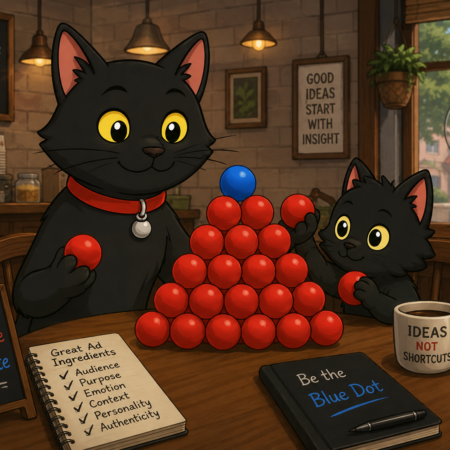
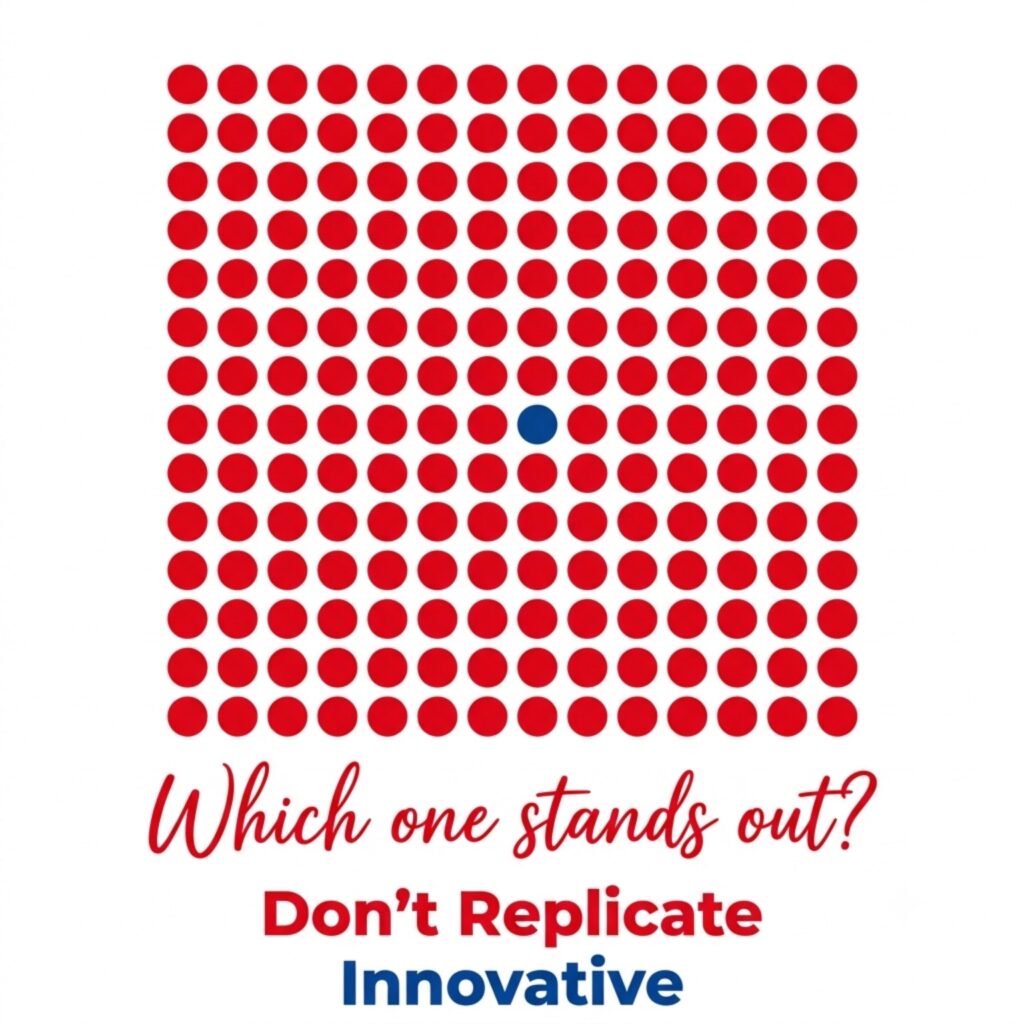
Then along comes one simple blue ball.
It catches your eye instantly.
Not because it is technically better than the others, but because it is different.
That is perhaps the biggest lesson businesses need to learn about using artificial intelligence in advertising.
AI is not the problem
Artificial intelligence has become the latest target for criticism. Many people complain that “everything made with AI looks the same.”
In reality, that is only half the story.
The problem is rarely the technology.
The problem is how people use it.
Ask an AI to “create me an advert” and it will do exactly what you asked. It will analyse millions of examples of successful advertising and produce something that fits the request. Just like it does for everyone else.
Technically, it has done an excellent job.
Creatively, however, it has almost no chance.
Not because the AI lacks imagination, but because it has not been given any.
Technology amplifies intent. It does not replace it.
You cannot bake a cake without ingredients
Imagine walking into a bakery and saying:
“Bake me a cake.”
The baker would naturally have questions.
What flavour?
Who is it for?
How many people?
Is it a birthday?
Does anyone have allergies?
Should it be elegant, fun or luxurious?
Without those ingredients, the result will probably be a perfectly acceptable plain sponge cake.
Artificial intelligence works in exactly the same way.
If you provide almost no information, it can only produce a generic answer.
The more context you provide, the more original the result can become.
The shortcut mentality
Many businesses have fallen into the same trap.
They buy an AI subscription.
Type one sentence.
Copy the first image or text it produces.
Post it online.
Then wonder why engagement is poor.
They have saved thirty minutes creating the advert, but may have lost hundreds of potential customers because the advert failed to connect with anyone.
Shortcuts save time.
They rarely build brands.
Every business is becoming the same
The irony is remarkable.
Businesses use AI because they want to stand out.
Yet by using identical prompts, they end up looking almost identical.
The same smiling models.
The same colour palettes.
The same motivational language.
The same polished perfection.
When every advert follows the same recipe, none of them become memorable. The difference isn’t the quality of the AI. It’s the willingness of the person using it to add the one ingredient that nobody else has. The blue ball.
The red ball disappears because everything has become red.
AI can stack all the balls perfectly. It cannot decide which one should be blue. That decision belongs to the human.
Artificial intelligence can organise information, generate ideas, refine language and produce beautiful visuals in seconds. What it cannot do is know what makes your business different. It does not know your story, your customers, your values or your ambitions unless you tell it. That is why the most important ingredient in any AI-generated campaign is not the prompt itself, but the thinking behind it.
Great advertising has always started with understanding
Long before artificial intelligence existed, successful advertising began with questions.
Who are we talking to?
What problem are we solving?
What emotion are we trying to create?
Why should somebody care?
Artificial intelligence has not changed those principles.
It has simply made it faster to execute them.
The thinking still belongs to the human.
AI is an amplifier
Perhaps the best way to think about AI is this:
It amplifies whatever you give it.
Give it a lazy prompt and it will produce a polished version of laziness.
Give it research, personality, customer insight, brand values, tone of voice, objectives, audience profiles and clear direction, and suddenly the results become far more powerful.
The quality of the output is still heavily influenced by the quality of the input.
Don’t ask for an advert
Ask for communication.
Ask for persuasion.
Ask for trust.
Ask for curiosity.
Ask for emotion.
Those are very different requests.
The AI then has something meaningful to work with.
Be the blue ball
The image above is deceptively simple.
Hundreds of identical red balls.
One blue one.
Your eye finds it immediately.
That is exactly what effective marketing should achieve.
Not because it shouts louder.
Not because it uses more technology.
But because it is different for a reason.
Artificial intelligence is one of the most remarkable creative tools ever developed.
It is not replacing good marketing.
It is exposing bad marketing.
Businesses that simply replicate what everyone else is doing will disappear into the crowd.
Those that innovate, communicate their unique story and use AI as a creative partner rather than a shortcut will continue to stand out.
Just like the blue ball.
- Don’t replicate. Innovate.
- AI can stack all the balls perfectly. It cannot decide which one should be blue.
- Technology amplifies intent. It does not replace it.